
The Stewardship Preparedness Framework
Understanding how future stewards develop the preparedness required for the responsibilities they will eventually inherit —
not just the knowledge.
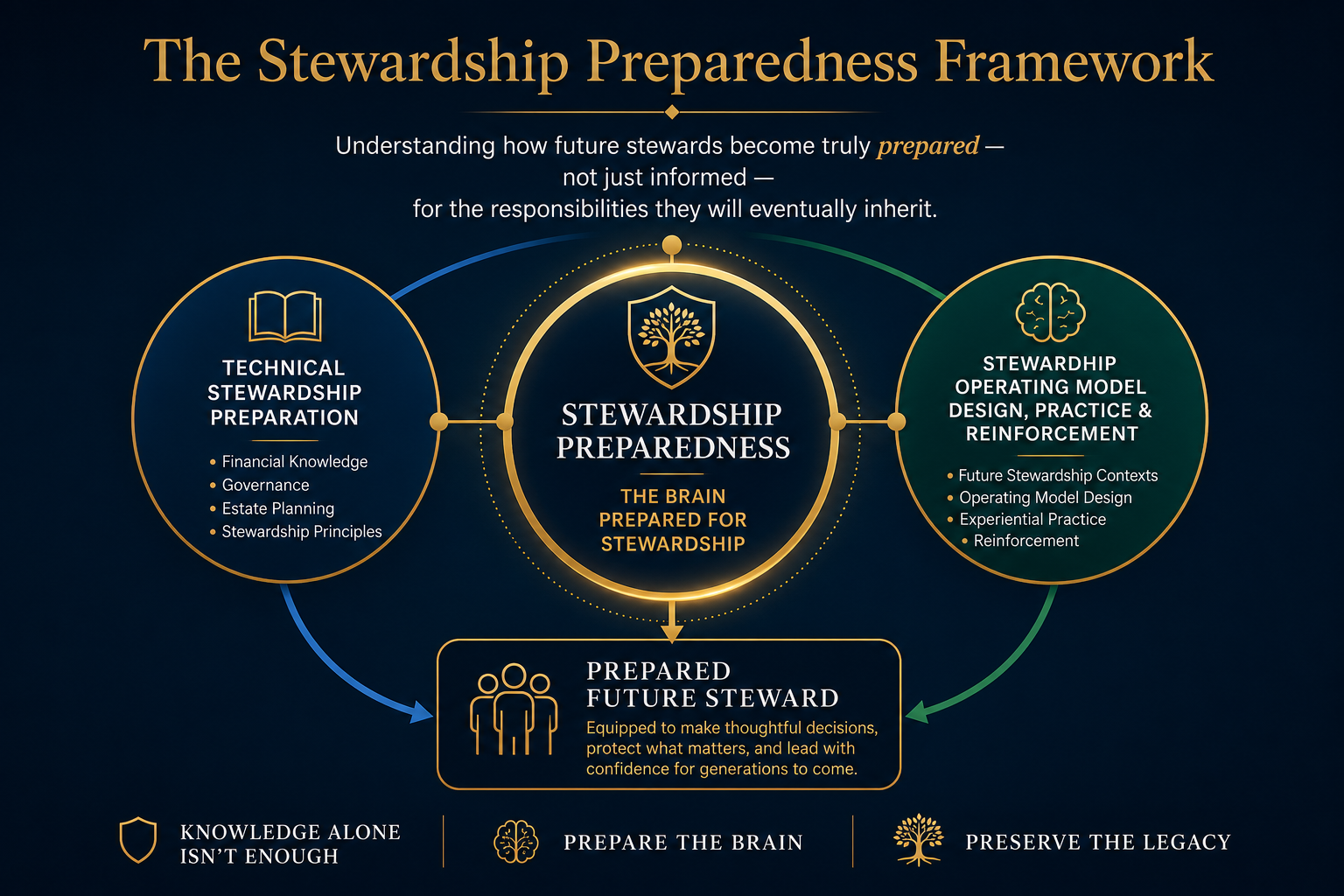
The Missing Link Between Technical Preparation and Stewardship Preparedness
Families who are serious about preserving wealth already invest heavily in technical stewardship preparation through financial education, governance, estate planning, philanthropy, taxation, and stewardship education.
These forms of preparation are essential and should continue.
Yet decades of wealth transition research suggest that the greatest risks to successful wealth transitions are not primarily technical —
they arise from the decisions, relationships, and behaviors of the people entrusted to steward the wealth.
That raises an important question.
If families are already investing heavily in technical preparation, what prepares the brain that will ultimately be responsible for making those stewardship decisions?
That is the missing link.
Technical stewardship preparation teaches future stewards what responsible stewardship looks like.
Stewardship preparedness prepares the brain to recruit the stewardship operating models required when stewardship responsibilities become real.
That is the purpose of
The Stewardship Preparedness Framework.
Technical stewardship preparation and stewardship preparedness are not competing approaches —
they are complementary.
One prepares future stewards with knowledge.
The other prepares the brain to apply that knowledge when stewardship becomes real.
Technical Stewardship Preparation
Builds financial knowledge
Teaches governance principles
Explains stewardship responsibilities
Transfers technical knowledge
Outcome
Future stewards understand what responsible stewardship looks like.
Stewardship Preparedness
Identifies the operating models likely to be recruited
Evaluates their predicted long-term value
Designs healthier stewardship operating models
Reinforces them through experience
Outcome
The brain is prepared to recruit stewardship operating models when stewardship becomes real.
Why Knowledge Alone Doesn't Create Stewardship Preparedness
If future stewards are taught what responsible stewardship looks like, why wouldn't they simply do what they've been taught?
Because the brain doesn't automatically adopt (predict) a new way of thinking or behaving simply because it has been taught one.
Instead, it recruits the operating model it predicts has the best chance of meeting the future steward's own needs in that particular situation.
Those predictions have been shaped through a lifetime of experiences —
not by what someone else believes the future steward should do.
Simply teaching a stewardship operating model does not convince the brain to adopt it.
The brain must repeatedly and consistently experience the new stewardship operating model doing a better job of meeting the steward's own needs than the operating models it has relied upon throughout life.
Only then does the brain begin to predict that the new operating model is the better solution.
There is another challenge.
The stewardship context doesn't actually begin until the future steward becomes personally responsible for stewarding the family's wealth —
in other words, when they are finally in the driver's seat.
Until that moment, the brain has never actually experienced stewardship. It has only learned about it.
When stewardship becomes real, the brain recruits the operating models it predicts have the best chance of meeting the steward's own needs in that situation based on the most similar situations it has experienced before.
Until stewardship operating models have already been
intentionally developed tested through experience and reinforced until the brain predicts them to provide greater value
it will naturally rely on operating models developed in other areas of life instead.
Those operating models may have been highly successful in other life contexts —
but they were never developed for stewardship.
That is why stewardship preparedness is different from, but complementary to, stewardship education.
That is the purpose of
The Stewardship Preparedness Framework.
How the Stewardship Preparedness Framework Works
Preparing future stewards requires more than transferring knowledge.
It requires intentionally preparing the brain for the stewardship situations it will eventually encounter by ensuring it has operating models that it predicts will successfully meet the steward's own needs while producing the stewardship outcomes the wealth creator or family office hopes to achieve.
1. Define the Stewardship Vision & Contexts
Working with the wealth creator or family office, identify the stewardship situations the future steward is most likely to encounter together with the values, principles, and stewardship philosophy they hope will guide decisions in those situations.
Examples include:
Receiving the inheritance
Investment decisions
Working with siblings
Leading family meetings
Philanthropy
Conflict resolution
Preparing the next generation
2. Identify Likely Recruited Operating Models
Identify the operating models from other areas of life that are most likely to be recruited into each stewardship situation.
Because the stewardship context is new, the brain has not yet developed stewardship-specific operating models.
As a result, it will recruit operating models from the most experientially similar contexts it has encountered throughout life.
3. Evaluate Their Predicted Stewardship Value
Evaluate whether the operating models most likely to be recruited are predicted to consistently meet the steward's own needs while also producing the stewardship decisions, behaviors, and outcomes desired by the wealth creator or family office.
This evaluation determines whether each operating model is appropriate for the stewardship context.
4. Re-anchor or Develop Stewardship Operating Models
Determine whether the operating models most likely to be recruited can successfully support stewardship in this new context.
If they can, intentionally re-anchor those operating models to the stewardship context so the brain learns to recruit them as its stewardship operating models.
If they cannot, intentionally develop new stewardship operating models designed specifically for the responsibilities, values, and principles established by the wealth creator or family office while also providing the steward's brain with a better way of meeting its own needs.
5. Build Predictive Confidence
Simply teaching stewardship operating models is not enough.
The brain does not automatically predict a new operating model simply because someone explains it.