What Effect Will the Wealth You Spent a Lifetime Creating Have on Your Children?
You may have spent years preparing your wealth for transfer.
Are your children psychologically prepared for the life they will live after they inherit your wealth?
only 26% of wealth givers believe their beneficiaries are very prepared for their inheritance.
RBC Wealth Management
over 60%
of high-net-worth individuals are concerned about how family wealth may affect their heirs' personal motivation for success.
Bank of America Private Bank
Have You Ever Wondered...
● Will they be able to handle the wealth once it becomes theirs?
● Will the wealth enrich their lives — or undermine their motivation, purpose, independence, or sense of identity?
● Will the wealth exacerbate concerns I already have about the way they conduct their lives?
● Will siblings be able to make important decisions together without conflict when they share ownership of family assets?
● How will spouses, partners, friends, and other outside influences affect their decisions?
Preparing Heirs Psychologically for Life After Inheriting Wealth
Families can spend years preparing wealth for transfer.
But who is preparing the people who will receive it?
Inherited wealth changes the context of an heir's life — bringing new freedoms, responsibilities, decisions, relationships, influences, and questions of purpose and identity.
Heir Preparedness is a neuroscience-based process designed to psychologically prepare heirs for life with inherited wealth — before the wealth transfers.

The Brain Navigates the Present Using What It Learned From the Past
The nervous system predicts how to navigate life largely from what lived experience has taught it.
And therein lies the challenge with inherited wealth.
THE SAME LIFE.
BUT NOW THERE'S MONEY.
Inherited wealth changes the context of situations the heir already encounters.
Stress. Spending. Achievement. Relationships. Status. Independence. Conflict.
The heir already has ways of navigating these situations. But inherited wealth can add greater resources, freedom, access, and opportunity — while removing constraints that previously limited the consequences of their choices.
Existing patterns of behavior can suddenly become far more consequential.
A LIFE THEY'VE
NEVER LIVED BEFORE.
Inherited wealth also introduces situations the heir has never experienced before.
Financial freedom. Responsibility for wealth they didn't create. Shared family ownership. Consequential investment decisions. Purpose without financial necessity.
Without lived experience in these situations, the nervous system must navigate them using what it learned from other experiences in the past.
Past learning is being asked to navigate a future it wasn't developed for.
IN BOTH CASES...
The heir's brain is being asked to navigate life with inherited wealth using what it learned BEFORE inherited wealth was part of their life.
How This Can Look Like in Real Life
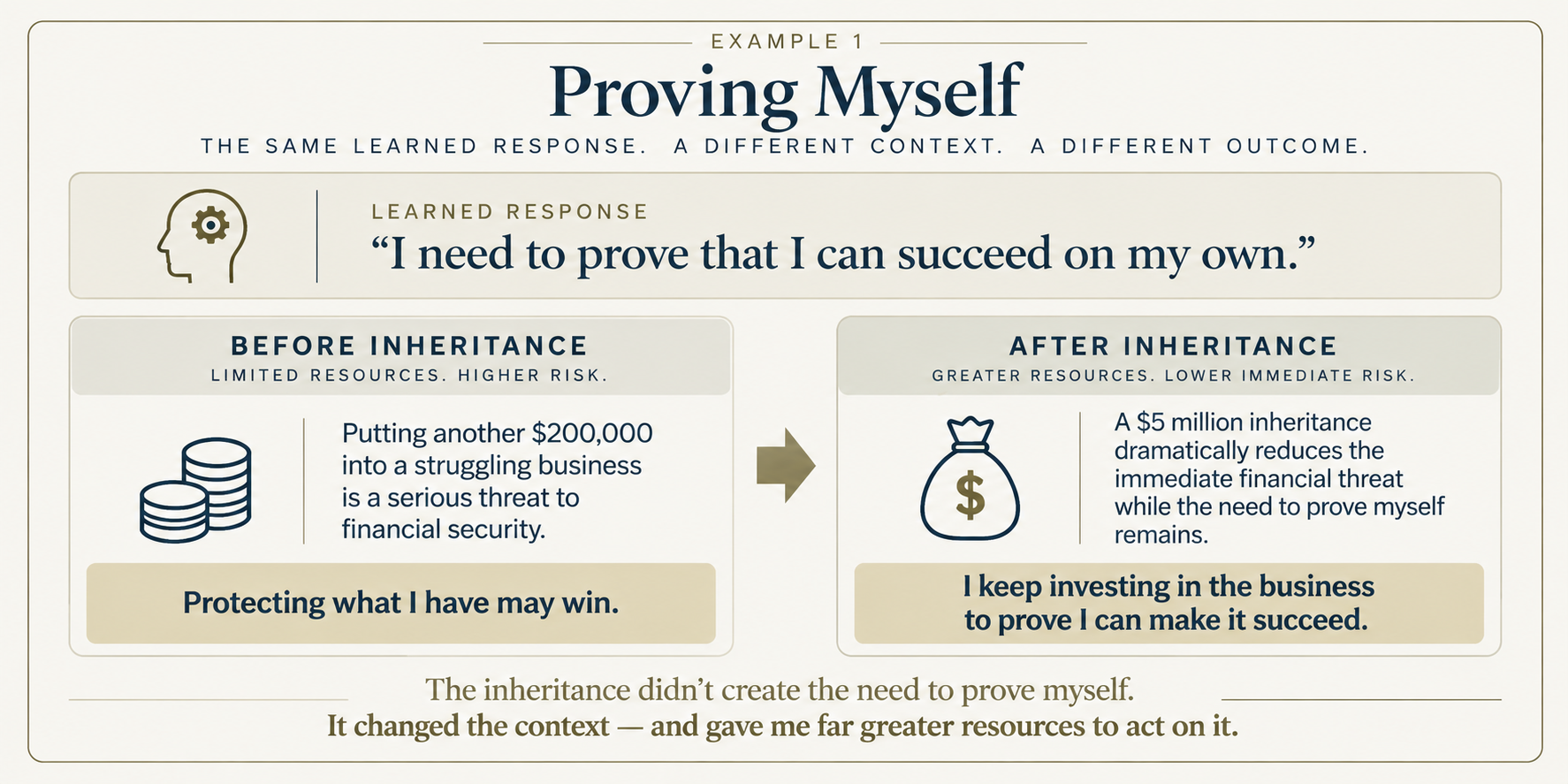
Inherited wealth doesn't necessarily create the pattern of behavior that produces the problem.
It can change the context — and remove the constraints that previously limited its consequences.
Imagine an heir who owns a business he started himself. The business is struggling and needs another $200,000 to keep going.
Proving that he can succeed on his own has become important to how he sees himself and his self-worth.
What happens to that decision when he inherits $5 million?
The Same Dynamic Can Play Out in Different Ways
KEEPING THE PEACE - “Giving in avoids conflict.”
With inherited wealth, avoiding conflict can begin influencing consequential family and financial decisions.
STATUS & SIGNIFICANCE — “What I own shows that I’ve made it.”
Greater resources can remove the constraints that once limited lifestyle spending and status-seeking.
FAIRNESS — “I have to fight to make sure I’m treated fairly.”
Existing family tensions can become conflicts over wealth, ownership, and joint decisions.
COPING — “This helps me escape or feel better.”
Greater resources and freedom can allow existing coping behaviors to become more frequent, extreme, and damaging.
The inheritance didn't create these patterns.
Buy it changed the context in which they operate — and potentially the consequences that follow.
A Major Life Transition Like Inheriting Wealth Requires Psychological Preparation
Inheriting wealth doesn't simply change an heir's finances. It changes the context of their life.
Some situations will be experientially familiar —
but suddenly inheriting wealth changes the choices, freedoms, resources, and consequences within these situations.
Other situations will be entirely new.
As a result…heirs can't be expected to psychologically navigate a major life transition they've never experienced before — without preparing for it.
Families will spend years preparing the wealth for transfer — through estate planning, trusts, tax planning, investment management, and financial education.
But who is preparing the heir for the life they will live after the wealth transfers?
Parents prepare their children for major transitions throughout their lives — schooling, dating, first jobs, career choices, marriage, having their own children…
Inheriting wealth deserves preparation too.
What Heir Preparedness Is Designed to Do
Heir Preparedness is a neuroscience-based process designed to psychologically prepare heirs for the life they will live after inheriting wealth —
BEFORE the wealth transfers.
We identify how inherited wealth is likely to change the heir's life —
both the situations they already navigate and the new situations inheriting wealth will create.
Then we help the heir develop more effective ways of navigating those situations and give them meaningful experience doing so before the actual inheritance.
And Earlier Is Better
This preparation shouldn't wait until a wealth transfer is imminent. It can begin years — even decades — before the anticipated transfer.
Starting earlier gives the heir more time and experience to develop and strengthen how they will navigate life with inherited wealth BEFORE the consequences become much higher.
The first time an heir experiences life with inherited wealth shouldn't be after the wealth has already transferred.
The Actual Inheritance Shouldn't Be the Training Ground.