$124 TRILLION of FAMILY WEALTH is CHANGING HANDS by 2048
More than 70% of heirs are likely to change financial advisors after inheriting their parents' wealth.
The Great Wealth Transfer creates an enormous challenge for wealth advisory firms:
retaining the assets when the person who owns them changes.
Do you have a relationship with the person who will own your client's assets next?
The opportunity to earn the heir's business begins BEFORE the wealth transfers.
HEIR PREPAREDNESS CREATES AN EARLY OPPORTUNITY TO EARN THE HEIR'S BUSINESS
Heir Preparedness is a neuroscience-based process designed to psychologically prepare heirs — before the wealth transfers — for the life they will live after inheriting wealth.
Why before?
Because psychological preparation requires more than knowing what to do.
It requires meaningful experience navigating life with wealth
That necessary experience creates a natural role for the family's wealth advisor.
You provide the financial expertise and work directly with the heir while Heir Preparedness provides the specialized psychological preparation.
In the process, this is your opportunity to build a relationship with the heir BEFORE the wealth transfers
For the family, the purpose is preparing the heir.
For the advisor, it creates a legitimate, client-centered reason to begin working with the person who may eventually own your client's assets — years before the transfer occurs.
That gives you time to build the relationship, demonstrate your value firsthand, and earn the heir's ongoing business.
And the earlier the better.
The earlier preparation begins, the more time the heir has to develop — and the more time you have to develop the relationship.
You’re not asking the heir to choose you AFTER they inherit.
You're earning the opportunity to be their advisor BEFORE they do.
Help Your Clients Prepare Their Heirs — While Strengthening Your Practice
Heir Preparedness gives you a neuroscience-based resource for helping clients address an important question:
Are my children psychologically prepared for life after inheriting my wealth?
By bringing Heir Preparedness to your clients, you can:
HELP PRESERVE AUM ACROSS GENERATIONS
Build meaningful relationships with heirs BEFORE the wealth transfers, increasing the likelihood they retain your firm while helping prepare them to make effective ownership decisions once the assets become theirs.
ENABLE DIFFICULT CLIENT CONVERSATIONS
Give clients a constructive way to address concerns about how their children will navigate life after inheriting wealth.
STRENGTHEN CLIENT RELATIONSHIPS
Help clients address not only how their wealth will transfer, but how it will affect the people and family they love.
DIFFERENTIATE YOUR PRACTICE
Bring families a dimension of wealth-transfer preparation that other advisors do not offer and are not equipped to provide themselves.
We Partner With Wealth Advisors — We Don't Compete With Them
Heir Preparedness is designed to complement the work you already do with families, not compete with or replace it.
Your client engages and pays Heir Preparedness directly. There is no cost to you or your firm.
Our role is to help address an important client concern that falls outside your traditional expertise —
while creating a natural opportunity for you to work directly with the heirs as part of their preparation.
You remain the wealth advisor — building the relationship with the heir and providing the financial expertise.
We provide the specialized psychological preparation.
Together, we prepare both the wealth AND the person who will eventually own it.

You See the Challenges. But Can You Explain Why They Happen?
Your clients may already wonder what inherited wealth could mean for their children's motivation, purpose, decision-making, behavior, relationships, and relationship with wealth itself.
Recognizing those concerns is one thing.
Understanding WHY inheriting wealth can create them is another.
The nervous system learns how to navigate life largely from lived experience. Inheriting wealth changes that equation in two important ways:
THE SAME LIFE. BUT NOW THERE'S MONEY.
The heir already has existing ways of navigating stress, spending, achievement, relationships, status, independence, and conflict.
But inherited wealth can add resources, freedom, access, and opportunity — while removing constraints that previously limited the consequences of their choices.
A LIFE THEY'VE NEVER LIVED BEFORE.
Inherited wealth also introduces situations the heir has never experienced — financial freedom, responsibility for wealth they didn't create, shared family ownership, consequential investment decisions, and purpose without financial necessity.
Their nervous system must initially navigate those situations using what it learned from other experiences in the past.
And Even The Wealth Itself Can Mean Something Entirely Different.
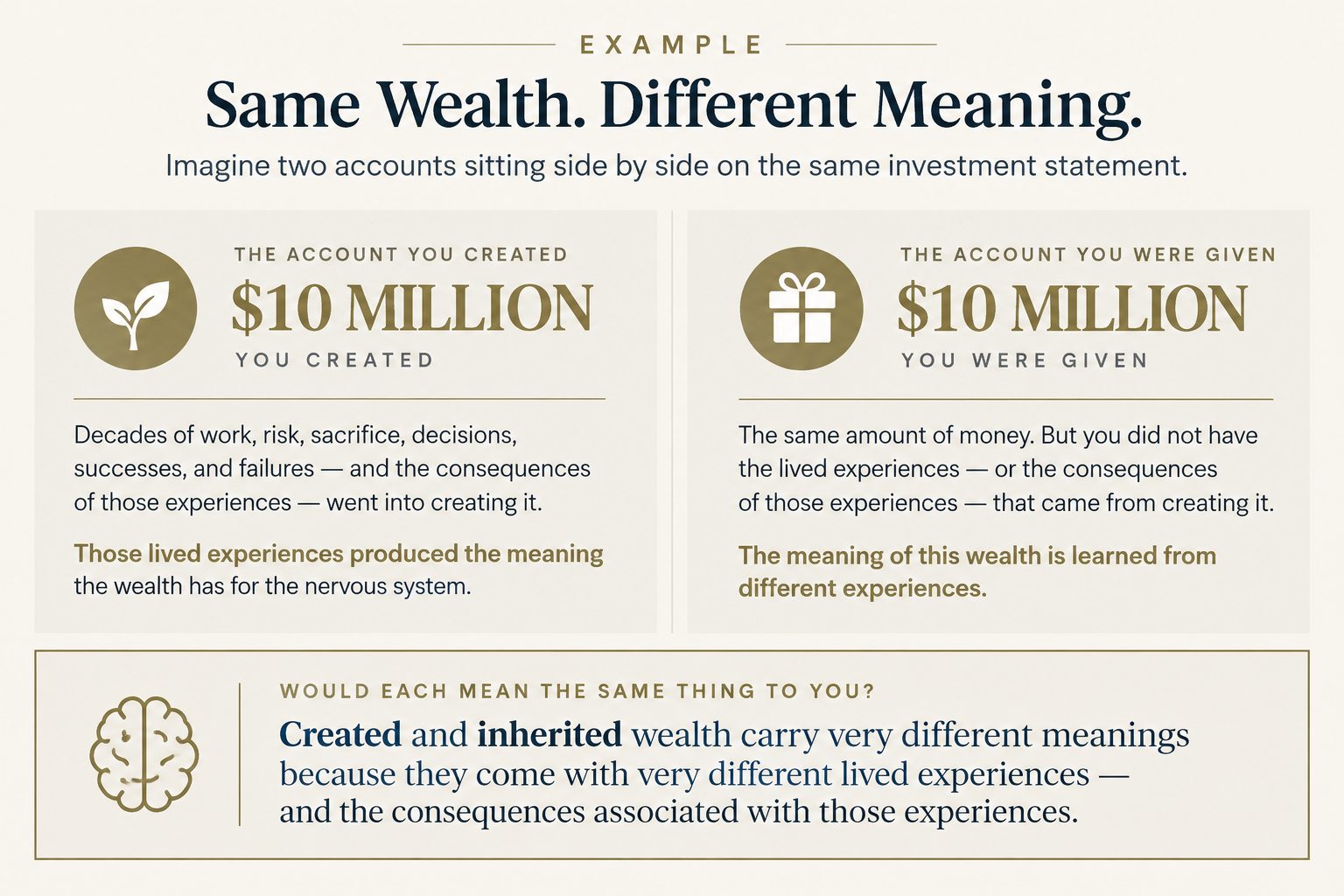
The dollar amounts in each account may be the same.
But the lived experiences associated with them are not — which means the wealth itself can have a very different meaning to the nervous system.
Knowing What to Do Is Not the Same as Being Prepared to Do It
Financial education can teach an heir important principles about investing, spending, taxes, risk, diversification, and managing wealth.
But knowing what to do does not mean the nervous system will recruit that knowledge when the heir is actually navigating the new situations inherited wealth creates.

The same principle applies to inherited wealth.
An heir can understand responsible wealth management intellectually. But understanding what to do is different from being psychologically prepared to navigate life with inherited wealth.
Preparation requires more than knowledge.
It requires experience applying what has been learned in the situations where it will actually be needed.
Recognizing the Concern Is One Thing. Knowing How to Address It Is Another.
Both you and your client may already have concerns about whether the heir is prepared for the life inherited wealth will create.
But recognizing the concern doesn't necessarily lead to action.
For the wealth creator, conversations about inheritance can mean confronting their own mortality —
while discussing wealth, responsibility, expectations, and preparedness with their children can be difficult.
For the advisor, raising the issue can be difficult too.
And eventually comes the question that matters most:
“So what do we do about it?”
This is where Heir Preparedness changes the conversation.
We give you the language and tools to raise the issue with your client, explain why psychological preparation matters, and respond to their questions.
And when your client is ready to act, Heir Preparedness provides the neuroscience-based process for psychologically preparing the family and heir.
Instead of simply identifying a concern, you can offer your client a constructive next step:
“Inherited wealth will introduce your children to a life they haven't experienced before. We can help prepare them for it — BEFORE they have to live it.”
You don't have to become the expert in heir preparedness.
We equip you to have the conversation — and provide the process when your client is ready to act.